
Table of Contents
Overview
The August 2026 Feature Updates release adds a parallel California BHSA chronic homelessness calculation alongside the existing HUD calculation. Data Analysis users will see two side-by-side groups instead of one in Looker.
| Before | After |
| One field group: Chronically Homeless | Two field groups: Chronically Homeless (HUD) and Chronically Homeless (BHSA) |
Introduction to the BHSA Chronically Homeless Fields
The BHSA Chronically Homeless fields appear in a new field group (Chronically Homeless (BHSA)) in the Client, Coordinated Entry, Data Quality, HMIS Performance, and Population Over Time models.
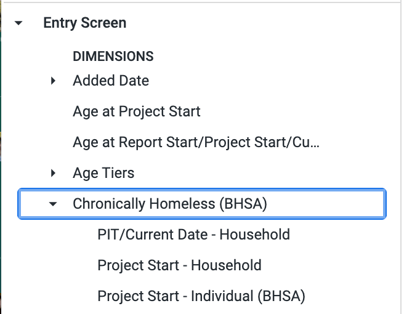
The fields calculate a client and/or household’s presumed chronic homelessness status (“Yes” or “No”) for each enrollment based on the definition provided in section C.4.1.2 Chronically Homeless of the California Behavioral Health Services Act County Policy Manual. If information to determine chronic homelessness is missing or unknown in the enrollment, this field will return “Missing” or “DK/PNTA.”
These new Looker fields can be pulled into custom reports to assist communities in determining:
- Whether or not specific enrollments or households may meet the definition of chronically homeless under these requirements, based on fields entered on the Enrollment screen
- How many enrollments or households may meet the definition of chronically homeless under these requirements, based on fields entered on the Enrollment screen
However, grantees are responsible for determining final eligibility for participants.
Details on the BHSA Chronic Homelessness Definition
Section C.4.1.2 Chronically Homeless of the California Behavioral Health Services Act County Policy Manual states:
“DHCS is adopting the Department of Housing and Urban Development (HUD) definition of chronic homelessness, identified under 24 CFR 91.5 with two modifications, as follows:
The requirement that a discontinuous period of 12 months of homelessness over the last three years occur on at least four separate occasions is eliminated; any number of occasions will suffice so long as the combined duration equals at least 12 months."
Note: The new BHSA chronic homelessness fields calculate chronic homelessness in alignment with this section of the definition.
“Consistent with the Medi-Cal modification to the definition of "homeless,” anyone residing in an institutional care facility, defined according to the HMIS definition of “institutional situations,” who was chronically homeless prior to entry retains that status upon discharge, regardless of length of stay.”
Note on entries from institutional situations: The FY 2026 HMIS Data Standards Manual only requires data collection for the total number of months homeless for clients in an institutional prior living situation if the stay is less than 90 days.
The DHCS-BHSA HMIS Project Set-up Instructions (V1.1) also states that:
“BHSA recipients should collect and enter the fields appropriate to that project type and funding program in alignment with guidance provided within HUD’s manual.”
Therefore, if a community is using System Enrollment screens, the full data needed to calculate chronic homelessness status is not collected, and the Looker fields will indicate “Missing” for BHSA chronic homelessness status for clients in an institutional prior living situation if the stay is greater than 90 days.
“Additionally, anyone who was chronically homeless prior to the receipt of Transitional Rent or prior to the receipt of housing funded by MHSA and is transitioning from either of these services to Housing Interventions services will be considered chronically homeless under Housing Interventions.”
Note on Transitional Rent and MHSA-funded housing: Because no standardized guidance for entering Transitional Rent or MHSA-funded program data into HMIS has been provided, this criteria cannot be accounted for in the Looker fields.
However, communities can use the Inbound Recidivism - Previous Exit Information dimensions in Looker to identify the program exited immediately prior to a client’s enrollment in a BHSA-funded program and determine whether it meets the criteria in this section of the definition based on their local configuration.
Complete BHSA Chronic Homelessness Fields Release
This release adds a parallel California BHSA chronic homelessness calculation alongside the existing HUD calculation across the chronic_homeless derived table views. Nothing HUD-related was changed logically; the HUD fields were only relabeled for clarity now that a second standard exists.
As noted in the introduction section above, in Looker, users will see two side-by-side groups instead of one.
| Before | After |
| One field group: Chronically Homeless | Two field groups: Chronically Homeless (HUD) and Chronically Homeless (BHSA) |
Existing fields had their label changed to add "(HUD)." They contain the same underlying SQL/logic. This change is purely a relabel so users can tell the two standards apart in the field picker.
The BHSA fields, visible to all users (no access-grant restriction), appear right alongside them:
- Chronically Homeless at Project Start – Individual (BHSA) — "Yes"/"No"/"DK/PNTA"/"Missing" dimension, parallel to the HUD one.
- Chronically Homeless Project Start – Household (BHSA) — same, at the household level.
- Chronically Homeless at PIT/Current Date – Household (BHSA) — parallel to the existing HUD point-in-time household field.
- Count Chronically Homeless Households (BHSA) — a new measure, parallel to the existing HUD count measure.
How the BHSA definition actually differs from HUD
- Length of time homeless: HUD requires either ≥365 days in the current episode, or ≥4 qualifying occurrences totaling >12 months over 3 years. BHSA drops the "4 occurrences" requirement — it only needs the 12-month total, regardless of how many episodes it took
- Institutional stay condition (3.917): HUD only counts a stay in an institution if it was ≤90 days. BHSA removes that 90-day cap entirely — a longer institutional stay will not disqualify a client from meeting chronic homeless status when other criteria are met.
- Both standards otherwise share the same household/PIT aggregation shape (data-quality-check fallback codes 8/9/99/"Missing"/"DK/PNTA" for incomplete data), so the two are comparable fields rather than one replacing the other.
Net effect for a Looker user: they can now report chronic homelessness under either standard from the same explore, filter/pivot by whichever definition their program needs, and the BHSA numbers will generally be equal to or higher than HUD's for the same household, since BHSA relaxes both the occurrence-count and institutional-stay restrictions.
New BHSA Fields
The following new fields were added to the Client, Coordinated Entry, Data Quality, HMIS Performance, and Population Over Time models.
| View | Group Label | Label | Description |
| Entry Screen | Chronically Homeless (BHSA) | Chronically Homeless at Project Start - Individual (BHSA) | "Using current CA BHSA logic, was client chronically homeless at project start." |
| LookML Field: | chronically_homeless_at_entry.is_chronic_homeless_BHSA | ||
| Entry Screen | Chronically Homeless (BHSA) | Chronically Homeless at PIT/Current Date - Household (BHSA) |
"Using HUD Point-In-Time logic and the BHSA Chronically Homeless rules, Is the client's household chronically homeless as of the current date? Project types different than ES, SO, & Safe Haven show a null value. If no member of the household is chronically homeless and the individual's information to determine chronic homelessness is missing or unknown this field will return 'Missing' or 'DK/PNTA.' " |
| LookML Field: | chronically_homeless_at_pit_household.chronically_homeless_at_pit_household_bhsa | ||
| Entry Screen | Chronically Homeless (BHSA) | Chronically Homeless Project Start - Household (BHSA) | "Using current BHSA logic, is a Client's Household considered Chronically Homeless." |
| LookML Field: | chronically_homeless_households.is_chronic_homeless_household_bhsa | ||
Updated Group Labels
The following updates are related and were made to the Client, Coordinated Entry, Data Quality, HMIS Performance, and Population Over Time models.
|
View |
Group Label |
Group Item Label |
| Entry Screen |
Previous Group Label: Chronically Homeless New Group Label: Chronically Homeless (HUD) |
Previous Group Item Label: Project Start - Individual New Group Item Label: Project Start - Individual (HUD) |
| LookML Field |
chronically_homeless_at_entry.is_chronic_homeless |
|
| Entry Screen |
Previous Group Label: Chronically Homeless New Group Label: Chronically Homeless (HUD) |
Previous Group Item Label: PIT/Current Date - Household New Group Item Label: PIT/Current Date - Household (HUD) |
| LookML Field |
chronically_homeless_at_pit_household.chronically_homeless_at_pit_household |
|
| Entry Screen |
Previous Group Label: Chronically Homeless New Group Label: Chronically Homeless (HUD) |
Previous Group Item Label: Project Start - Household New Group Item Label: Project Start - Household (HUD) |
| LookML Field |
chronically_homeless_households.is_chronic_homeless_household |
|
Additional Resources
Published: 08/07/2026