
Video Resources
Click through for a hands-on experience for Site/Building status updates logic that is described in this article:
Overview
Units and Beds in INVENTORY each have a "Status" for indicating whether the Unit/Bed is not in use due to repairs, cleaning, changes in a program's capacity, etc.
The status options are as follows:
- Active: The Unit/Bed is active and ready for use.
- Inactive: The Unit/Bed is not active. However, the Unit/Bed will not be deleted because the user needs to retain historical information. Inactive Units will not appear on the INVENTORY dashboard.
-
Offline: The Unit/Bed is temporarily unavailable (due to maintenance or another specific reason) but is expected to be online again in the future.
For Units, a status is selected when the Unit is created, and users can manually add an Inactive or Offline status as needed.
For Beds, the following logic applies:
- If a Unit is Offline, all Beds in the Unit will be Offline.
- If a Unit is Inactive, all Beds in the Unit will be Inactive.
- If a Unit is Active, users can manually add an Offline status as needed to any of the Beds in the Unit.
There are two options for manually adding a status:
- Through the MODIFY UNIT page
- Through the INVENTORY dashboard
Refer to the end of this article for additional logic regarding the effect of Unit Status and Unit Configuration Type on Bed Status.
Notes:
- If there is an overlap between Offline or Inactive status dates and a Unit occupancy resulting from a referral, the system will display a warning banner.

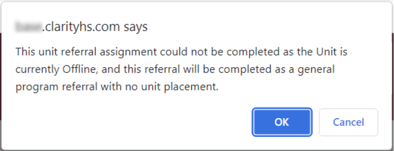
- If a future-dated "Offline" or "Inactive" status is added to a Unit that has a pending referral, and a user attempts to complete the pending referral for an occupancy that is during the Inactive/Offline data range, the system will display a pop-up saying that the referral will be completed to the program but not to the Unit.
Automatically Adding a Status
The system will automatically create and modify "Active" status records where there are gaps between "Inactive" and "Offline" status records.
If you want the system to automatically create an Offline status for a Unit or Bed when the client exits, enable the Automatic Offline Status function. Refer to our Automatic Offline Status article for details.
Manually Adding a Status on the MODIFY UNIT Page
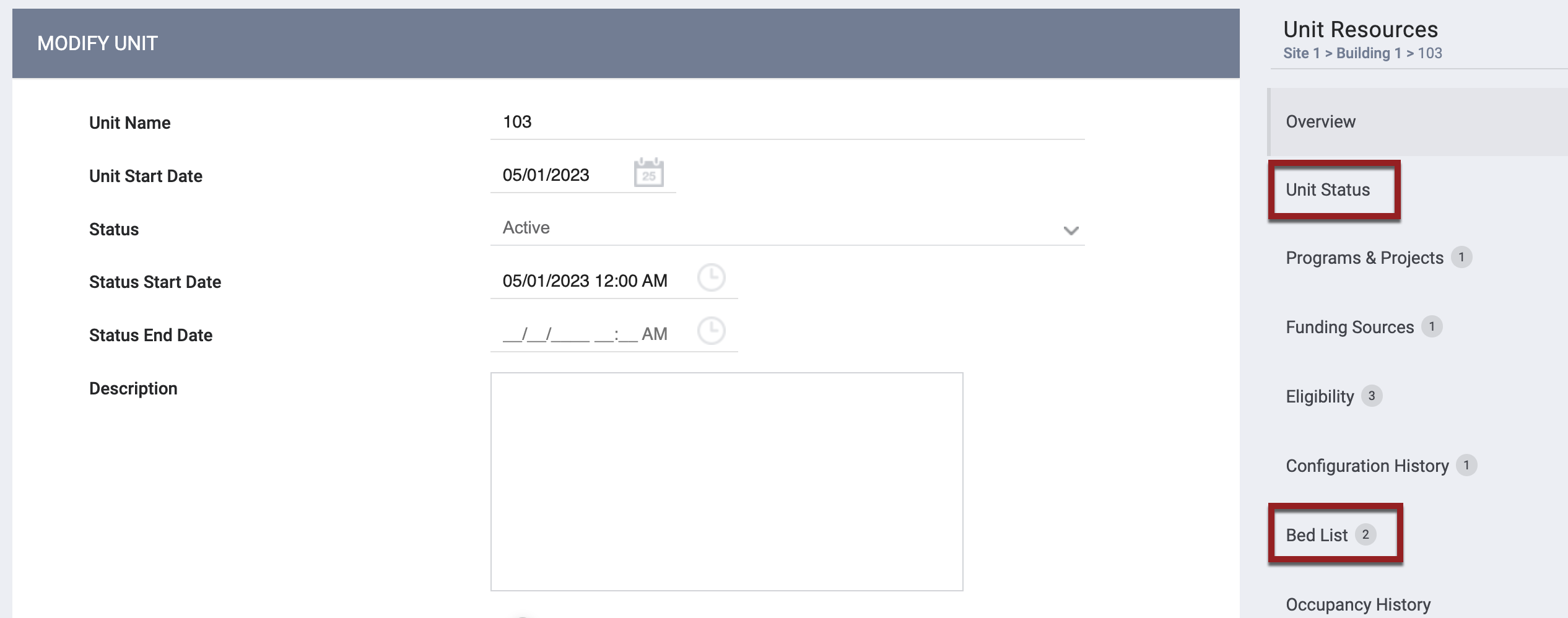
The Unit Resources sidebar on the MODIFY UNIT page allows users to add a status for that Unit or for any of the Beds in that Unit.
Adding an Inactive or Offline Status
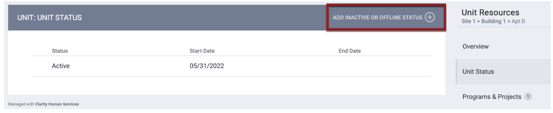
Users can add a Unit Status from the Unit Status section of the sidebar.- To add a Unit Status, select the Unit Status section of the sidebar and click ADD INACTIVE OR OFFLINE STATUS.
- To add a Bed Status, select the Bed List section of the sidebar and select a Bed to edit.
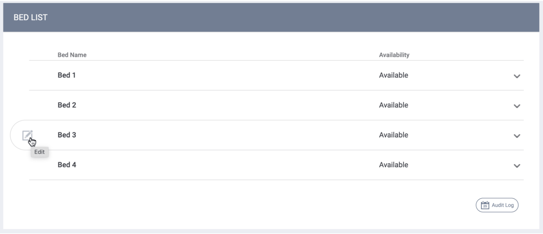
Then click ADD OFFLINE STATUS.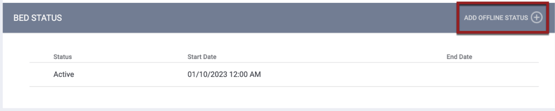
Notes:
- An Offline status can only be added to a Bed for dates when the Unit is Active.
- You will not be able to add an Offline or Inactive status for a Unit/Bed that has a pending referral or a future-dated occupancy.
The ADD STATUS pop-up appears for you to select the Status.
- For a Unit, select "Offline" or "Inactive."
- For a Bed, the only option will be "Offline."
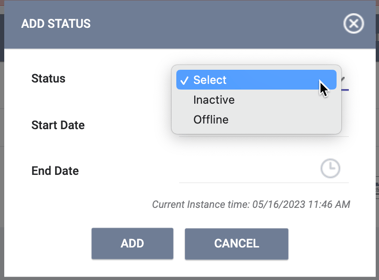
The Start Date field defaults to the current time (rounded to 15-minute increments) and date. To adjust the date and time, click the Start Date field, select the appropriate date and time, then click Done. Add an End Date if applicable.
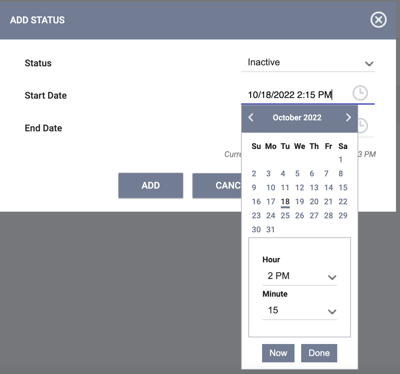
Note: A Unit /Bed can have more than one status in a day (for example, if a Unit needs to be offline from 1:00 pm - 5:00 pm for maintenance but is active before 1:00 pm and after 5:00 pm).
If you select "Offline" for the Status, you will also need to choose an Offline Reason from the drop-down menu. Enter any additional details in the optional Description field.
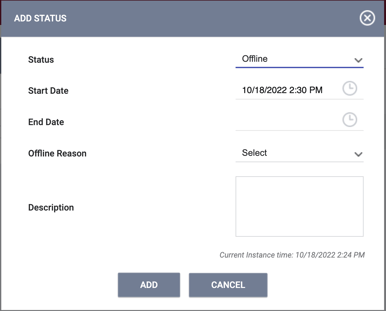
After completing the ADD STATUS pop-up, click ADD.
If you add an "Inactive" or "Offline" status with an End Date for a Unit that does not have an Inactive/Offline record starting the following day, the system displays a pop-up saying: "The [Status Name] End Date is set to [Status End Date]. This Unit will automatically become Active after the assigned 'Status Name' period ends, and an Active status record will be added on [end date plus 1 day] if there are no future date unit status records that begin on that date."
Note: If you attempt to enter a status with dates that overlap the dates of another status, the system will underline the date field(s) in red. You will not be able to save the new status until you adjust the date(s) accordingly.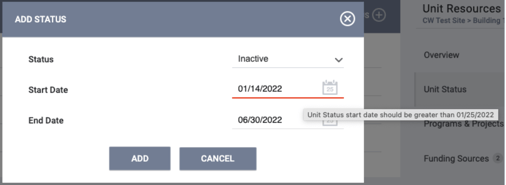
Active Status
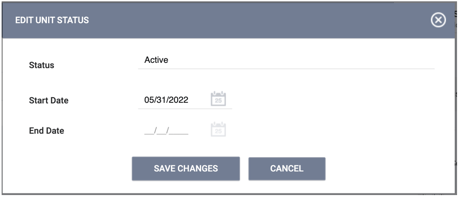
Users will not be able to add, delete, or modify "Active" records. The only exception is the Start Date of the original "Active" status, which is the first status record for a Unit. That Start Date cannot be changed to a date that is later than the Start Date of any Inactive/Offline status record or the earliest occupancy for the Unit.
How a Unit becomes "Active"
An "Inactive" or "Offline" status changes to "Active" automatically after the End Date passes for an "Inactive" or "Offline" status.
In the example below, after a user entered an "Offline" status for April 11-15, the system automatically created an "Active" status starting on April 16. While the original "Active" status can be edited, and the "Offline" status can be deleted or edited, the "Active" status that starts on April 16 cannot be deleted or edited because it was automatically added by the system.
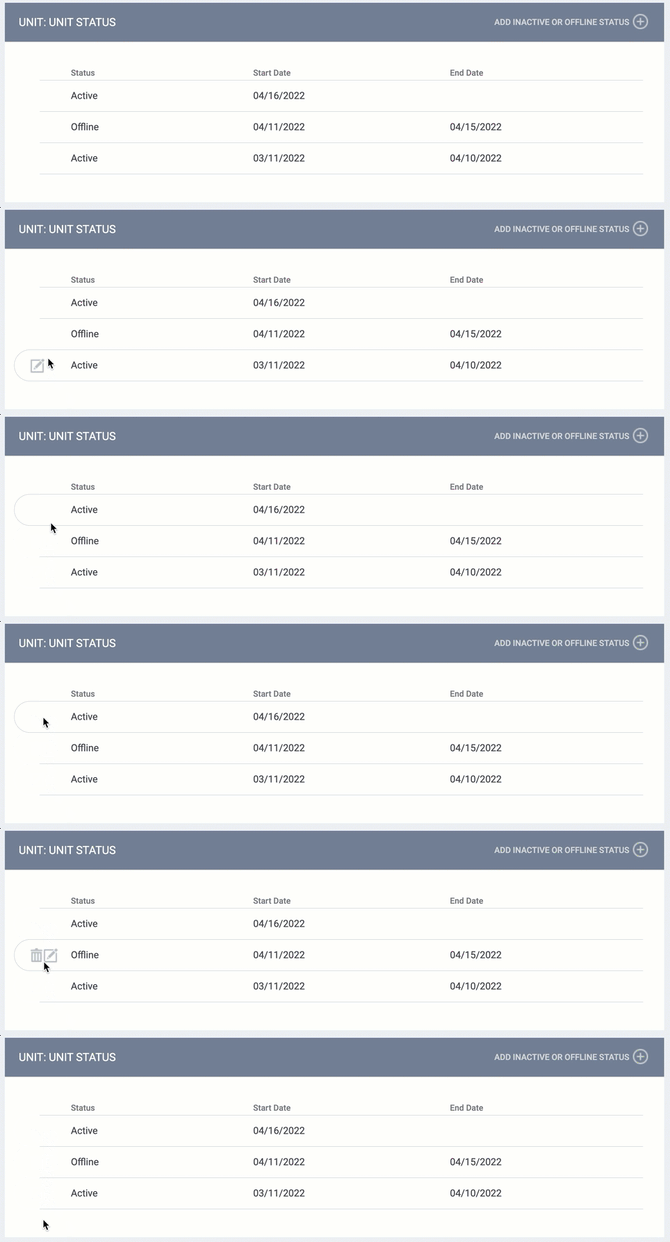
Users can edit an "Inactive" or "Offline" status and, if needed, update the End Date to an earlier date to prompt the system to automatically create an "Active" status.
For example, if the End Date for an "Inactive" or "Offline" status is set to end on a Wednesday and it needs to be active on a Monday, the user can edit the status and set the End Date 2 days earlier.
The system displays a pop-up saying: "The [Status Name] End Date is set to [Status End Date]. This Unit will automatically become Active after the assigned 'Status Name' period ends, and an Active status record will be added on [Status Start Date] if there are no future date unit status records that begin on that date."
Editing/Deleting a Status
Users can edit or delete an "Offline" or "Inactive" status for Units.
Users can delete or edit a manually added Bed status, but cannot delete or edit a Bed status that was inherited from the Unit.

Manually Adding a Status Through the INVENTORY Dashboard
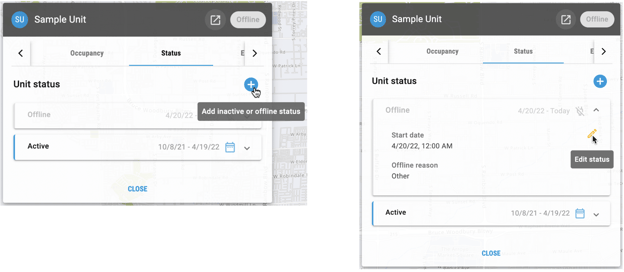
Users with the Inventory – Add Unit Status and Inventory – Edit Unit Status access role permissions. can add or edit Unit/Bed status on the Status tab on the Unit Card of the INVENTORY dashboard. Users need to be switched into the Unit’s agency to add/edit a status for an agency’s respective Unit.
The Status tab lists Unit Status records in chronological order, with the most recent status listed first. After a user clicks the plus sign to add a status, or the pencil icon to edit an existing status, the process is the same as described above.
Additional Logic for Unit/Bed Status
Status updates inherit down and any associated items automatically update.
Site/Building Status Updates
When a site or building status is updated, the status inherits down and any associated unit, bed, or Unit Configuration Type (UCT) automatically updates.
Inactive Status Logic
When the user wants to change a Site or Building status to "Inactive," the system checks if any units or beds within the associated Site or Building are currently occupied or have future occupancy date or have current/future-dated referrals.
- If there are any current occupancies or current pending referrals with the units or beds within the site or building, the status field for the site and building to which the unit/bed relates is read-only.
- When the user hovers over the Status field, the system displays a tooltip that reads:
"There are one or more units or beds within this [site or building] that are currently occupied or have pending referrals. Please make any necessary adjustments to change the status of the [site or building]."
- When the user hovers over the Status field, the system displays a tooltip that reads:
- If there are no current occupancies or current pending referrals, and there are any future occupancies or future-dated referrals to units/beds set up within the site/building, then when the user changes the site or building status to "Inactive," the user sees a warning indicating that the future occupancy/referral will be deleted.
- The warning reads:
"There are one or more units or beds within this [site or building] that have future occupancies or referrals. Changing the status of this [site or building] to ‘Inactive’ will delete the future occupancies or referrals. Please confirm."
There is an "OK" button and a "Cancel" button available.- If the user clicks OK, the future occupancy(ies)/referral(s) are deleted and the site/building status is changed to "Inactive."
- If the user clicks Cancel, the future occupancy(ies)/referral(s) are not deleted and the site/building status is not changed to "Inactive."
- The warning reads:
- If there are no current occupancies, no future occupancies, no current pending referrals, and no future-dated referrals associated with the units or beds within the site or building, the "Inactive" status update applies to the site or building.
- If the "Inactive" status is applied to the site/building, the "Inactive" status applies to all entities set up under the site/building.
- The "Inactive" Start Date for the units, and beds is the date and time the "Inactive" status is applied to the site/building. The "Inactive" End Date in this case is empty until the user changes the site/building status back to active. Buildings and UCTs do not have a status Start or End Date, so the date doesn’t apply to UCTs or buildings.
- If there is a current inactive status for a unit/bed set up under the site/building and the user changes the site/building status to "Inactive," the system keeps the start date for the inactive unit/bed status as is and does not update unit/bed start date to the inactivity date for the site/building. The system clears the end date/time of current inactive status and fills it automatically when the site/building status is set back to active. The end date/time for the inactive status = date /time when the user sets the "Active" status for the site/building.
- If there is current offline status for a unit/bed set up under the site/building, and the user changes the site/building status to "Inactive," the system ends the offline status with the end date/time of the start of the inactive status. The system creates a new inactive status for this unit with a start date/time that matches the start date/time of the site/building’s inactive status.
- The "Inactive" status for the entities set up under the site/building cannot be modified or deleted while the site/building status remains "Inactive."
- The "Inactive" Start Date for the units, and beds is the date and time the "Inactive" status is applied to the site/building. The "Inactive" End Date in this case is empty until the user changes the site/building status back to active. Buildings and UCTs do not have a status Start or End Date, so the date doesn’t apply to UCTs or buildings.
- If there are any future inactive/offline statuses for units/beds within the building/site, when the user sets the site/building to "Inactive," they see a warning indicating that those future inactive/offline statuses will be deleted.
- The warning reads:
"There are one or more units or beds within this [site or building] that have future ‘Inactive’ and/or ‘Offline’ statuses. Changing the status of this [site or building] to ‘Inactive’ will delete the future ‘Inactive’ and 'Offline’ statuses. Please confirm."
There will be an "OK" button and a "Cancel" button available.- If the user clicks OK, the future "Inactive" and "Offline" statuses for the units/beds are deleted and the site/building status is changed to "Inactive."
- If the user clicks "Cancel, the future "Inactive" and "Offline" statuses are not deleted and the site/building status is not changed to "Inactive."
- The warning reads:
- If the "Inactive" status is applied to the site/building, the "Inactive" status applies to all entities set up under the site/building.
Active Status Logic
When the user changes the status of a site to "Active" from "Inactive," the "Active" status applies to the building, units, beds, and UCTs set up under the site.
- If the building, unit, bed, or UCT was inactive prior to the site being made inactive and then active again, the building, unit, bed, or UCT retains its inactive status.
- The "Active" Start Date for the units and beds is the date and time the "Inactive" status was changed to "Active." UCTs and Buildings do not have a status Start or End Date, so the date doesn’t apply to UCTs or Buildings.
When the user changes the status of a building to "Active" from "Inactive," the "Active" status applies to the units, beds, and UCTs set up under the building.
- The "Active" Start Date for the units and beds is the date and time the "Inactive" status was changed to "Active." UCTs do not have a status Start or End Date, so the date doesn’t apply to UCTs.
Existing Data Considerations
For existing data, any currently "Inactive" sites or buildings where there is a current occupancy, current pending referral, future occupancy, or future pending referral, are made "Active."
- If there is no current or future occupancy or pending referral to unit/bed or if there are any past occupancies, the site/building status remains "Inactive."
Audit Logs
When the user changes the status of a site/building to "Inactive," this is reflected in the audit log for the level where the changes were made and all lower levels, including Units/Beds.
Status Visibility
When the status of a site/building is changed, the status of the unit/bed is visible on the following pages:
- Listing within the Units page → Availability column
- Modify Unit page → Status field
- Unit → Unit Status page → Status column
- Unit → Bed List → Availability column
- Unit → Bed List → Modify Bed → Bed Status section → Status column.
Unit Status Updates
The logic for Bed status with respect to Unit status is as follows:
|
When this happens: |
The system does this: |
|
Unit status is updated. |
Bed status will be updated |
|
A Bed already has an Offline status, and a user adds an Offline status to the Unit. |
An additional Offline record is added to the Bed level.
|
|
A Bed with an Offline status is in a Unit that is made Inactive. |
The system updates the End Date of the Bed’s Offline status to right before the Start Date of the Unit’s Inactive status. |
|
User tries to apply an Inactive or Offline status to a Unit during a date range when any of its Beds are occupied or have a pending referral. |
The system won’t allow the user to save the Inactive or Offline status. |
|
A user deletes an Offline/Inactive status of a Unit. |
The system deletes the associated Offline/Inactive status of the Bed and displays the following pop-up warning: “By removing this [Unit Status Category] Unit Status, this will also remove the associated [Unit Status Category] Bed Status that was created.” |
|
A user changes the date for an Offline/Inactive status for a Unit. |
The system adjusts the associated Offline/Inactive status of the Bed and displays the following pop-up warning: “This Unit Status date update will also adjust the associated [Unit Status Category] Bed Status date range.” |
Unit Configuration Type Status Updates
The logic for Bed status with respect to the Unit Configuration Type (UCT) is as follows:
|
When this happens: |
The system does this: |
|
A UCT becomes the Current Configuration for a Unit. |
The Unit status at that time will be applied to the Beds associated with that UCT. |
|
A UCT moves from the Current Configuration section to the Unavailable Configurations section. |
Bed status is stored in the system and is end-dated.
|
|
A new Bed is added to a Unit’s current UCT. |
The Bed inherits the status that the Unit has on the date the Bed is added. |
Pending Occupancy Status Start Date
The logic for determining unit/bed availability status where status = 6 (Pending Occupancy) has been updated so that the "Pending Occupancy" status' start date is the date/time when the status began, and the end date is the occupancy start date.
Pending Occupancy End Date Usage
If a referral is connected to the client program, the unit_occupancy.pending_occupation_end_date is equal to the unit_occupancy.occupation_start_date.
- If the unit_occupancy.occupation_start_date is updated, the unit_occupancy.pending_occupation_end_date is also updated.
If a referral is denied or expired, the unit_occupancy.pending_occupation_end_date is equal to the referrals.end_date.
- If the referrals.end_date is updated, the unit_occupancy.pending_occupation_end_date is also updated.
When a referral is deleted, any occupancy data connected with the referral is also marked as deleted, including the pending occupancy.
The pending_occupation_end_date field is backfilled with past and current data.
Pending Occupancy Visibility
The pending occupancy end date is visible to users in the following places:
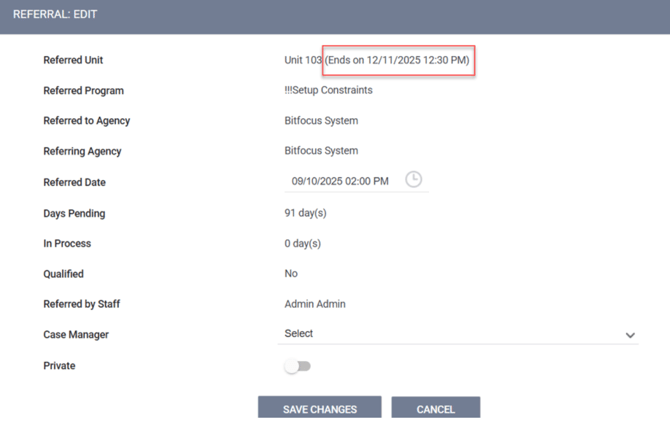
- Occupancy history page
- The referral record, next to the unit/bed name.
Updated: 02/13/2026