
Table of Contents
Overview
In Inventory, the UNIT CONFIGURATIONS section of the MODIFY UNIT page allows you to see which Unit Configuration Type (UCT) is currently in use for the Unit and to schedule future UCTs for that Unit.

- Current Configuration: This is the Unit Configuration Type currently in use. The first Unit Configuration Type added to a Unit will appear in this section with the date it was created and will remain until the Unit Configuration is changed.
- Upcoming Configurations: These are Unit Configuration Types that the Unit is scheduled to change to.
- Available Configurations: These are Unit Configuration Types that are neither Upcoming Configurations nor Unavailable Configurations.
- Unavailable Configurations: UCTs other than the one that is currently assigned to the Unit will appear here and remain here until you move them into Available Configurations or Upcoming Configurations.
Move a UCT
To move a UCT into or out of the Upcoming Configurations or Available Configurations sections, click on the UCT and drag it into the desired section.
Change a Unit's Current UCT
- Click on the desired UCT in the Upcoming Configurations or Available Configurations section.
- Drag the UCT into the Upcoming Configurations section.
- The ASSIGN UNIT CONFIGURATION pop-up appears. Enter the As Of Date to indicate when the UCT will become the Unit's Current Configuration.
Note: The As Of Date must be after the current UCT Unit Start Date.
- Click SAVE CHANGES.

The As Of Date will be displayed in the Upcoming Configurations section as the Start Date.

You cannot drag and drop UCTs directly into or out of Current Configurations. The only way for a UCT to move to Current Configuration is for the system to move it automatically from Upcoming Configurations to Current Configuration based on the Start Date.
Notes:
-
If a UCT is moved into Upcoming Configurations without having an assigned program, the system displays a warning banner:

The banner will remain until a program is assigned to the UCT. If a program is not assigned to the UCT before the UCT Start Date, the Unit will not appear in the Unit Queue or be included in the Available Units list in the Units tab.
- If you move a UCT into the Upcoming Configurations section and enter an As Of Date that is before the Unit Start Date, the system will underline the As Of Date in red.
-
If the number of Beds in a Unit's upcoming UCT is less than the number of Beds that are either occupied or have pending occupancy in the current UCT, the system sends a notification for the user to either end the current occupancy or adjust the upcoming UCT. Refer to Inventory: Beds for details.
- When a user assigns a new UCT to the Upcoming Configurations list for a Unit with an active occupancy that doesn't meet the upcoming UCT's eligibility criteria, the system displays the following pop-up: "Clients currently within this unit may no longer meet the eligibility requirements. Please make any necessary adjustments.”
- If the upcoming UCT was added to the Unit before the Unit was occupied, the system will check the eligibility when the UCT moves from an Upcoming Configuration to the Current Configuration. If at least one client occupying the Unit is not eligible for the upcoming UCT, the system will send the following email notification to the program Assigned Staff and the user who placed the client in the Unit:
"This client [hyperlink to client’s program Unit page] is currently within a unit where they no longer meet eligibility requirements due to a unit configuration change. Please review and update as appropriate."
Mapping Occupancies to the New UCT
When you change a Unit’s UCT, Clarity Human Services no longer changes bed statuses and bed identifiers automatically. Instead, you confirm how each occupancy moves to the new UCT. Clarity then carries bed statuses and bed identifiers forward wherever possible. This keeps historical reporting connected and reduces cleanup after a UCT change.
The Mapping Pop-Up
After you set the As Of Date, the ASSIGN UNIT CONFIGURATION mapping pop-up appears if the Unit has any of the following:
- A current occupancy
- A future occupancy
- A current pending occupancy
- A future pending occupancy
The pop-up lists every affected occupancy. Each row shows the client’s name and UID, the current bed and start date, and a list of the Units/Beds available in the new UCT. For each row, select a Unit/Bed from the list, or select End Occupancy. You must complete every row before you can save the change.
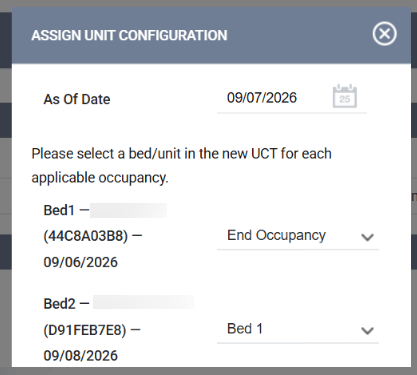
- Units/Beds with matching names in the current and new UCT are filled in automatically.
- Only eligible Units/Beds appear in the list. A Unit/Bed that another client occupies is hidden. The system checks eligibility for each client individually.
- A row that still needs an answer is marked in red, and SAVE CHANGES is not available until every row is complete.
Eligibility Override
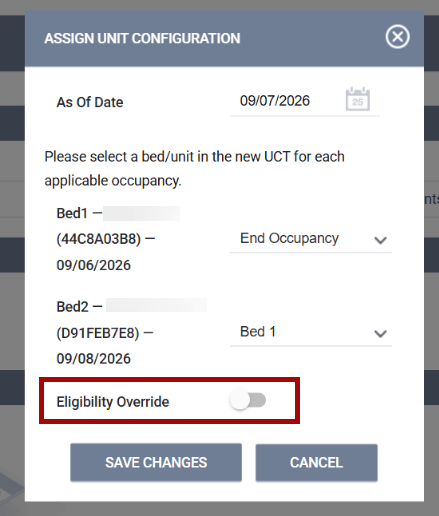
Users with the appropriate access can turn on the Eligibility Override toggle to see the full list of Units/Beds, including those the client is not eligible for. You need one of these access rights, depending on the type of record you are mapping:
- Referrals - Unit Eligibility Override
- Edit Enrollment-based Unit Records - Eligibility Override
What the Pop-Up Shows in Each Situation
|
If the change is… |
Then… |
|
The new UCT has the same number of Beds or more |
Select a Unit/Bed in the new UCT for each occupancy. |
|
The new UCT has fewer Beds than the current UCT |
The list includes End Occupancy for a client who cannot be placed. The end date is the last day the previous UCT is active. For example, if the As Of Date is 11/10/2026, the occupancy ends on 11/09/2026. |
|
The current UCT has Beds enabled, but the new UCT does not |
Select one client to stay on the Unit. The system sets End Occupancy for the remaining clients. If the As Of Date is earlier than an additional household member’s Occupancy Start Date, the system removes that occupancy instead of ending it. |
|
The current UCT does not have Beds enabled, but the new UCT does |
Select a Bed for the client currently in the Unit. Other household members appear under Additional Enrollment Household Members. Selecting a Bed for them is optional. |
Bed Statuses and Bed Identifiers
The system does not exit a client from a Bed when you change the UCT. It carries each Bed’s status and identifier forward based on your mapping:
- Same number of Beds: Each Bed status carries over to a Bed in the new UCT, and Bed identifiers stay matched one to one.
- More Beds in the new UCT: The status of each Bed in the former UCT carries over. The remaining Beds are set to Available. Every existing Bed identifier is kept, and the additional Beds receive new identifiers.
- Fewer Beds in the new UCT: The system carries over the status of each former Bed it can map. Every identifier that has a Bed to move to is kept.
Refer to Unit/Bed Status for how Bed statuses work with UCT changes.
Notifications
When a UCT change moves a client’s current occupancy to a different Unit/Bed, the enrollment’s assigned staff member receives an email and a Clarity Inbox notification. Refer to System Notifications for details.
Updated: 11/03/2026