
Table of Contents
Purpose
The New Customer Configuration dashboard was created to allow a way to monitor and review new customer configurations during setup in Clarity. The dashboard is broken down into eleven sections (CoC, Agency, Program, User, Screens, Templates, Services, Bed and Unit Inventory, Sharing Settings, Community Queue, and CE Assessment Information) to ensure convenient review of information with ease.
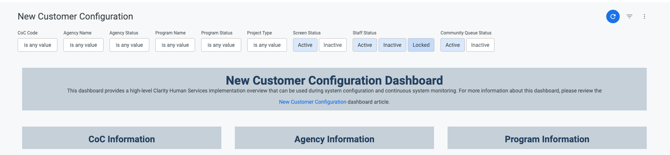
With filters, explore options, and the initial dashboard view, setup progress and needs can be easily identified. From a high-level, this dashboard will also be valuable to audit and review system configuration outside of the initial setup process as well.
Access and Location
Dashboards are available to all instances with Data Analysis enabled. This dashboard is a LookML Dashboard. How you access this dashboard depends on whether you use standalone or embedded Looker and the access rights assigned to your access role. At a minimum, your access role must have the Data Analysis access right enabled. For details on all access rights, see Rights Glossary for Access Roles.
Standalone Looker
This dashboard is accessible in Looker via the following path: All Folders > LookML Dashboards > New Customer Configuration.
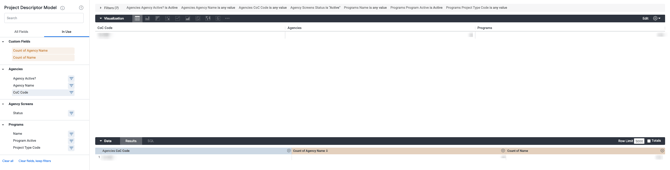
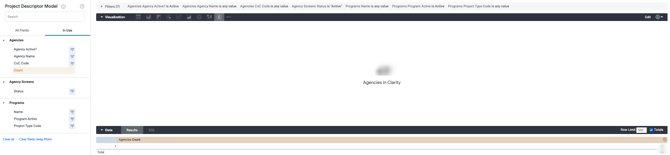
Once selected, your dashboard will start running. This dashboard utilizes the Project Descriptor Model.
Embedded Looker
This dashboard is accessible in Clarity by navigating to Reports > Data Analysis > Built In Reports > New Customer Configuration. Click Run to open and start running the dashboard.
LookML Dashboards accessed through embedded Looker must first be enabled in the Data Analysis settings before they're available. For steps to enable and access these reports, see the Embedded Looker: Looker - Clarity Human Services Integration article.
Dashboard Filters
The following filters are available for this dashboard:

|
Filter |
Selection Options and Defaults |
|
CoC Code |
Select the CoC(s) to include. Once selected, Agency Name, Program Name, and Project Type filters will update to only reflect information associated with the CoC(s) selected. Default: is any value |
|
Agency Name |
Select the agency(-ies) to include. Like CoC Code, this filter updates Program Name to show only programs associated with the selected agency(-ies). Default: is any value |
|
Agency Status |
Select the Agency Status (Active/Inactive Filter). Default: is any value |
|
Program Name |
Select the name(s) of the programs to include. Default: is any value |
|
Program Status |
Select the Program Status (Active/Inactive Filter). Default: is any value
|
|
Project Type |
Select the project type(s) to include. Default: is any value
|
|
Screen Status |
Select the Screen Status (Active/Inactive Filter) to filter tiles in the Screen Information section. Default: Active |
|
Staff Status |
Select the Staff Status (Active/Inactive/Locked Filter) to filter tiles in the User Information section. Default: Active, Inactive, and Locked |
|
Community Queue Status |
Select the Queue Status (Active/Inactive Filter) to filter tiles in the Community Queue and CE Assessment Information sections. Default: Active |
Filter Breakdown
The list below shows which filters apply to each section of the dashboard. In addition to this reference, each tile has an info bubble next to the Look’s title that lists all applicable filters.
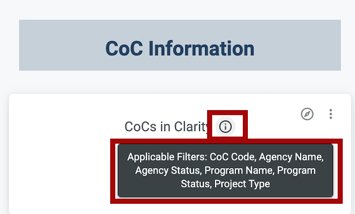
|
Section or Look |
Applicable Filters |
|
CoC Information, Agency Information, Program Information, Template Information, Services Information, and Current Bed and Unit Inventory Information sections |
CoC Code, Agency Name, Agency Status, Program Name, Program Status, Project Type |
|
User Information section |
Staff Status |
|
Screen Information section |
Screen Status |
|
Sharing Settings section |
CoC Code, Agency Name, Agency Status, Project Type |
|
Community Queue Information section CE Assessments Connected to CQs and CE Assessing Program -> CE Assessments -> Community Queue Flow Looks |
CoC Code, Community Queue Status |
|
Assessment Details Look |
Community Queue Status |
All filters are optional. However, using filters may make the setup analysis more streamlined. Filters in this dashboard are not limited to single select.
Dashboard Tiles
The dashboard contains 11 sections highlighting various counts, charts, and tables associated with agencies, programs, users, screens, templates, services, bed and unit inventory, sharing settings, community queue, and CE assessments that are currently in Clarity.
CoC Information
The CoC Information section includes the CoCs in Clarity and Agency & Program Count per CoC tiles.
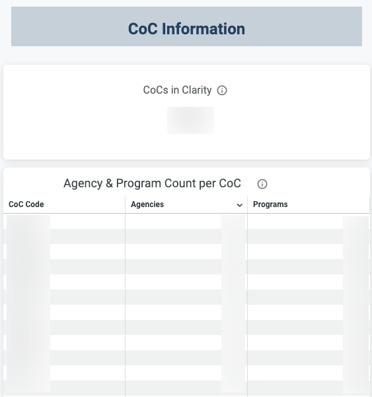
CoCs in Clarity
This Look contains a single-value visualization of the current count of CoCs in Clarity.
- Custom Fields
-
- Count of CoC Code (Agencies)
- “Explore from Here”
- There are no drill downs available for this Look.

Agency & Program Count per CoC
This Look contains a table listing applicable CoC Codes and the associated Agency and Program counts for each CoC.
- Dimensions
-
- CoC Code
- Custom Fields
-
- Count of Agency Name
- Count of Name (Program)
- “Explore from Here”
-
- There are no drill downs available for this Look. Information on Agencies and Programs will be found in the following dashboard sections.
Agency Information
The Agency Information section includes the Agencies in Clarity and Agency Detail tiles.
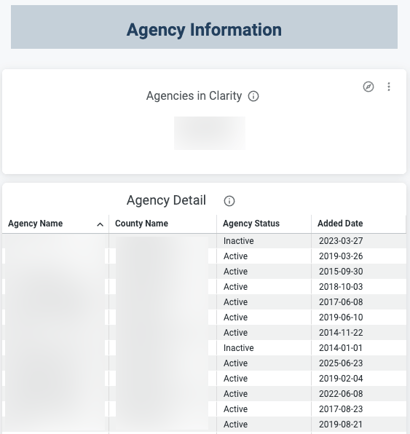
Agencies in Clarity
This Look contains a single value visualization of the current count of agencies that are in Clarity.
- Measures
-
- Count (Agencies)
- “Explore from Here”
- There are two ways to explore this Look to obtain more information.
- Select “Explore from Here”, then click on the count in the data section for a drill down containing Agency ID, Agency Name, CoC Code and Agency Status.
- This drill down Look can also be achieved by selecting the count of agencies on the dashboard tile.
- There are two ways to explore this Look to obtain more information.
Agency Detail
This Look contains a table visualization of agencies, county name, agency status and date added.
- Dimensions
-
- Agency Name
- County Name
- Agency Active?
- Added Date - Date
- “Explore from Here”
- Selecting “Explore from Here” will show the same table from the dashboard.
- Two drill down options are available.
- “By Programs Name”
- Select an Agency Name to produce a list of programs associated with the agency
- “By Added Time”
- Select an Added Date for a drill down of all agencies added on that date and the added time
- “By Programs Name”
- Two drill down options are available.
- Selecting “Explore from Here” will show the same table from the dashboard.

Program Information
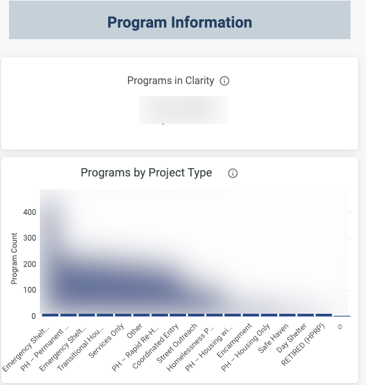
The Program Information section includes the Programs in Clarity and Programs by Project Type tiles.
Programs in Clarity
This Look contains a single value visualization of the current programs in Clarity.
- Measures
-
- Programs - Count
- “Explore from Here”
- There are two ways to explore this Look to obtain more information.
- Select “Explore from Here”, then click on the count in the data section for a drill down containing Program ID, Program Name, Project Type, Program Status, Agency Name and Agency ID.
- This drill down Look can also be achieved by selecting the count of agencies on the dashboard tile.
- There are two ways to explore this Look to obtain more information.

Programs by Project Type
This Look contains a column visualization of the current project type counts in Clarity.
- Dimensions
-
- Programs - Project Type Code
- Measures
-
- Programs - Count
- “Explore from Here”
- For more information, select any Programs Count for a drill down containing the Program ID, Name, Project Type Code, Program Active, Agency Name and Agency ID for the associated Project Type Code.

User Information
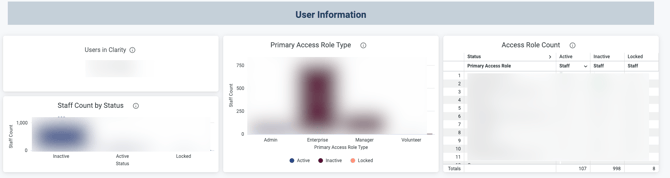
The User Information section includes the Users in Clarity, Staff Count by Status, Primary Access Role Type, and Access Role Count tiles.
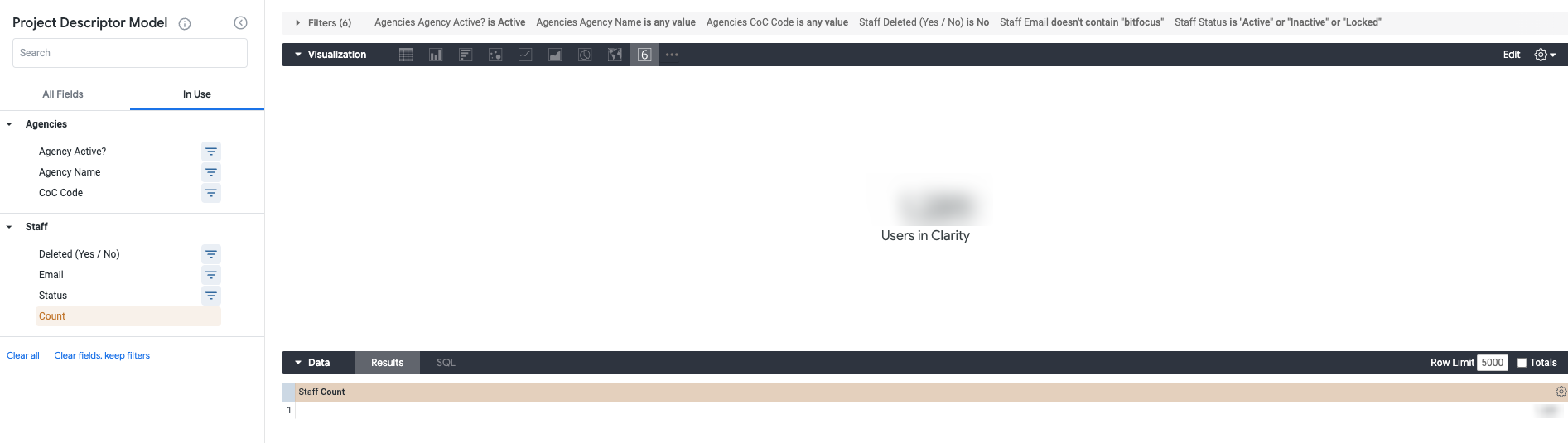
Users in Clarity
This Look contains a single value visualization of the current count of users that are in Clarity.
- Measures
-
- Staff - Count
- “Explore from Here”
- There are two ways to explore this Look to obtain more information.
-
-
- Select “Explore from Here”, then click on the count in the data section for a drill down containing User ID, First Name, Last Name, and Status.
- This drill down Look can also be achieved by selecting the value on the dashboard tile.
- Note: If the row limit is reached, download results for a complete list of users.
-
Staff Count by Status
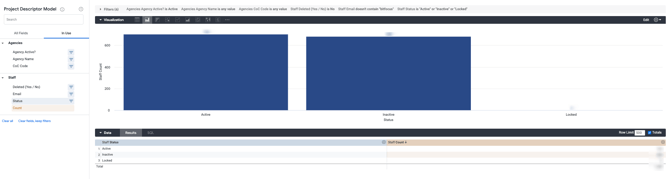
This Look contains a column visualization containing counts of staff by status (active, inactive and locked).
- Dimensions
-
- Staff - Status
- Measures
-
- Staff - Count
- “Explore from Here”
- Selecting the values in the Staff Count column provides a drill down including User ID, First Name, Last Name and Status.
Primary Access Role Type
This Look contains a column visualization of the current primary access role type counts in Clarity. Each column is broken down by staff status.
- Dimensions
-
- Staff - Primary Access Role Type
- Staff - Status
- Measures
-
- Staff - Count
- “Explore from Here”
- Select any value in the Staff Count columns for a drill down containing the User ID, First Name, Last Name, and Status.

Access Role Count
This Look contains a table with access role information and counts broken down by staff status.
- Dimensions
-
- Staff - Primary Access Role - Name
- Staff - Status
- Measures
-
- Staff - Count
- “Explore from Here”
- Select any value in the Staff Count columns for a drill down containing the User ID, First Name, Last Name, and Status.

Screen Information
The Screen Information section includes the Screens in Clarity and Screen Type tiles.
Screens in Clarity
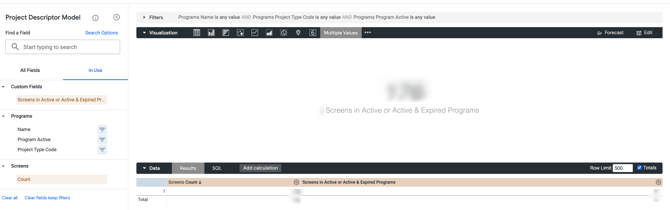
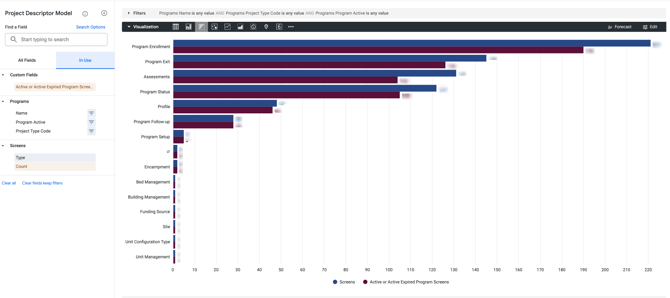
This Look contains a multiple-value visualization showing the total count of screens configured in Clarity alongside a comparison value of screens used by active or active & expired programs.
- Measures
-
- Screens - Count
- Custom Measures
- Screens in Active or Active & Expired Programs - Count
- “Explore from Here”
- There are two ways to explore this Look to obtain more information.
- Select “Explore from Here”, then click on the Screens - Count in the data section for a drill down containing Screen ID, Screen Name, and Screen Type.
- This drill down Look can also be achieved by selecting the Screens - Count value on the dashboard tile.
- There are two ways to explore this Look to obtain more information.
Screen Type
This Look contains a column visualization displaying screen counts broken down by screen type for all Clarity screens and active or active & expired programs.
- Dimensions
-
- Screens - Type
- Measures
-
- Screens - Count
- Custom Fields
- Active or Active & Expired Program Screens - Count
- “Explore from Here”
- Select any value in the Screens Count column for a table containing the Screen ID, Screen Name and Screen Type.
Template Information
The Template Information section includes the Templates in Clarity and Template & Program Count tiles.
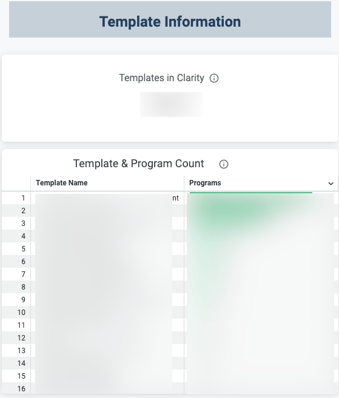
Templates in Clarity
This Look contains a single value visualization of the current count of templates currently linked to a program in Clarity.
- Custom Fields
-
- Count of Template Name
- “Explore from Here”
- There are no drill downs available for this Look.

Template & Program Count
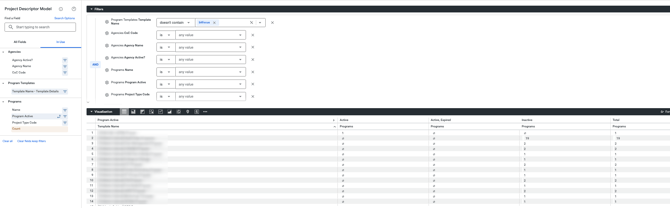
This Look contains a table of the current templates in Clarity and a count of the programs utilizing them.
- Dimensions
-
- Programs - Template Name
- Program Active (Pivoted)
- Measures
-
- Programs - Count
- “Explore from Here”
- Select any value in the Programs Count column for a drill down containing Program ID, Name, Project Type Code, Program Active, Agency Name and Agency ID for the associated Project Type Code.
Services Information
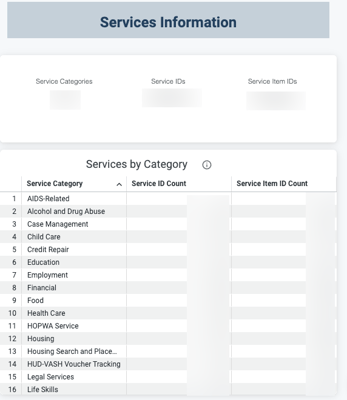
The Services Information section includes the Service Categories, Service IDs, Service Item IDs, and Services by Category tiles.
Services - Service Categories, Service IDs & Service Item IDs
This Look contains a multiple values visualization with counts for unique service categories, service IDs and service item IDs.
- Custom Fields
-
- Count of Service Category
- Count of Service ID
- Count of Service Item ID
- “Explore from Here”
- There are no drill downs available for this Look.

Services by Category
This Look contains a table with Service ID and Service Item ID counts per Service Category.
- Dimensions
-
- Service Category
- Custom Fields
-
- Count of Service ID
- Count of Service Item ID
- “Explore from Here”
- There are no drills available for this Look.

Current Bed and Unit Inventory Information
The Current Bed and Unit Inventory Information section includes the Active Bed and Unit Counts by Project Type and Active Bed and Unit Inventory Detail tiles.
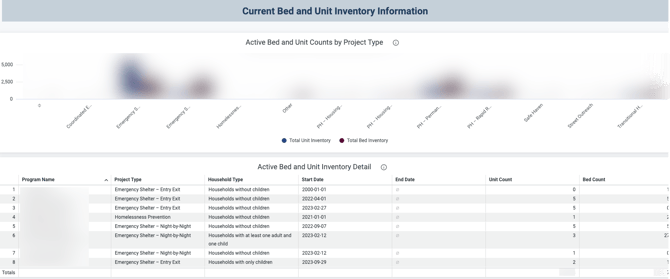
Active Bed and Unit Counts by Project Type
This Look contains a grouped column visualization with counts of current, available bed and unit inventory broken down by project type.
- Dimensions
-
- Project Type Code
- Measures
-
- Total Bed Inventory - Bed and Unit Inventory
- Total Unit Inventory - Bed and Unit Inventory
- Custom Filter
${program_inventory.start_month}<=now()

AND (${program_inventory.end_date}>now()

OR is_null(${program_inventory.end_date}))
- “Explore from Here”
- Select any value from the Total Inventory columns for a drill down containing Agency ID, Agency Name, Program ID, Program Name, Bed Inventory ID, Household Type, Availability Bed Type and Total Unit Inventory

Active Bed and Unit Inventory Detail
This Look contains a table with active bed and unit inventory information including Program Name, Project Type, Household Type, Start Date, End Date and Total Unit and Bed Inventory Counts.
- Dimensions
-
- Program Name
- Project Type
- Household Type - Bed and Unit Inventory
- Start Date - Bed and Unit Inventory
- End Date - Bed and Unit Inventory
- Measures
-
- Total Bed Inventory - Bed Allocations
- Total Unit Inventory - Bed Allocations
- “Explore from Here”
- Selecting values from the Total Bed Inventory or Total Unit Inventory columns provides a drill down for the selected row with Agency ID, Agency Name, Program ID, Program Name, Bed Inventory ID, Household Type, Availability Bed Type and Total Unit Inventory.
- Selecting a value from the totals row provides a list with Agency ID, Agency Name, Program ID, Program Name, Bed Inventory ID, Household Type, Availability Bed Type and Total Unit Inventory for all applicable inventories.

Sharing Settings
The Sharing Settings section includes the Agency Sharing Settings tile.
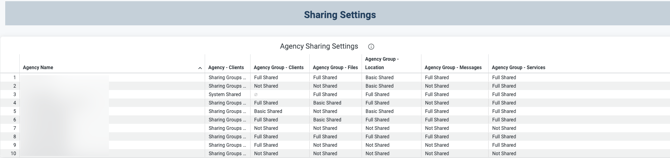
Agency Sharing Settings
This Look contains a table with Agency Name and Sharing Settings (Agency Level Settings - Clients, Group - Clients, Files, Location, Messages and Services)
- Dimensions
-
- Agency Name
- Agency - Clients
- Agency Group - Clients
- Agency Group - Files
- Agency Group - Location
- Agency Group - Messages
- Agency Group - Services
- “Explore from Here”
- There are no drill downs available for this Look.

Community Queue Information
The Community Queue Information section includes the Community Queues and Community Queue Detail tiles.
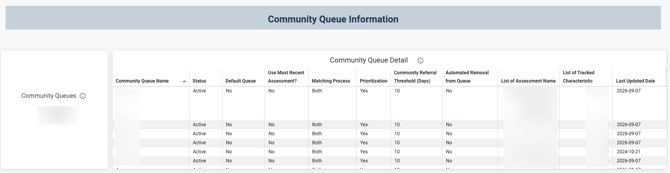
Community Queues in Clarity
This Look contains a single value visualization of the active Community Queues in Clarity.
- Measures
-
- Referral Community Queues - Count
- “Explore from Here”
- There are two ways to explore this Look to obtain more information.
- Select “Explore from Here”, then click on the count in the data section for a drill down containing Community Queue ID, Community Queue Name, and Default Community Queue.
- This drill down Look can also be achieved by selecting the count of agencies on the dashboard tile.
- There are two ways to explore this Look to obtain more information.
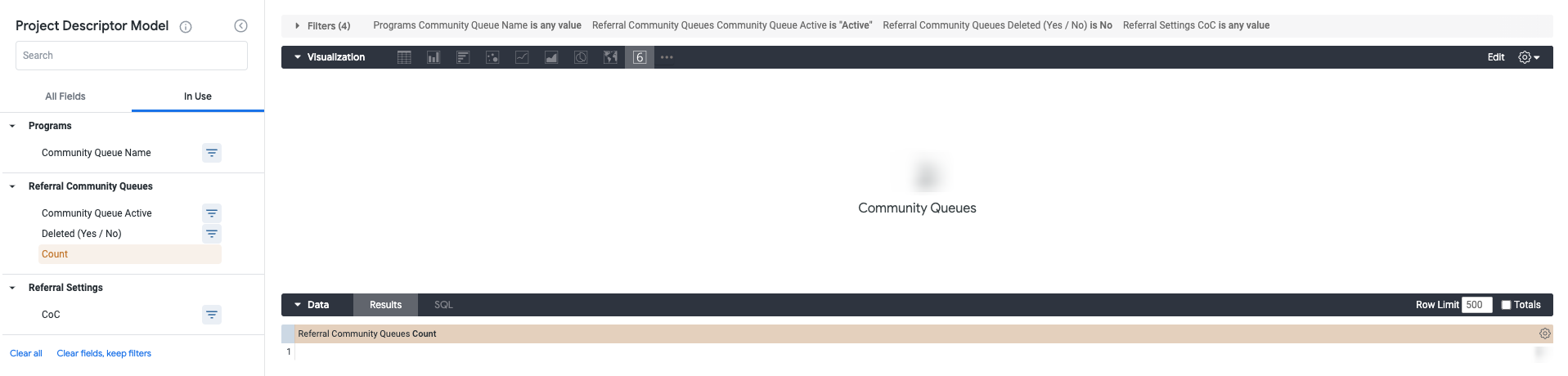
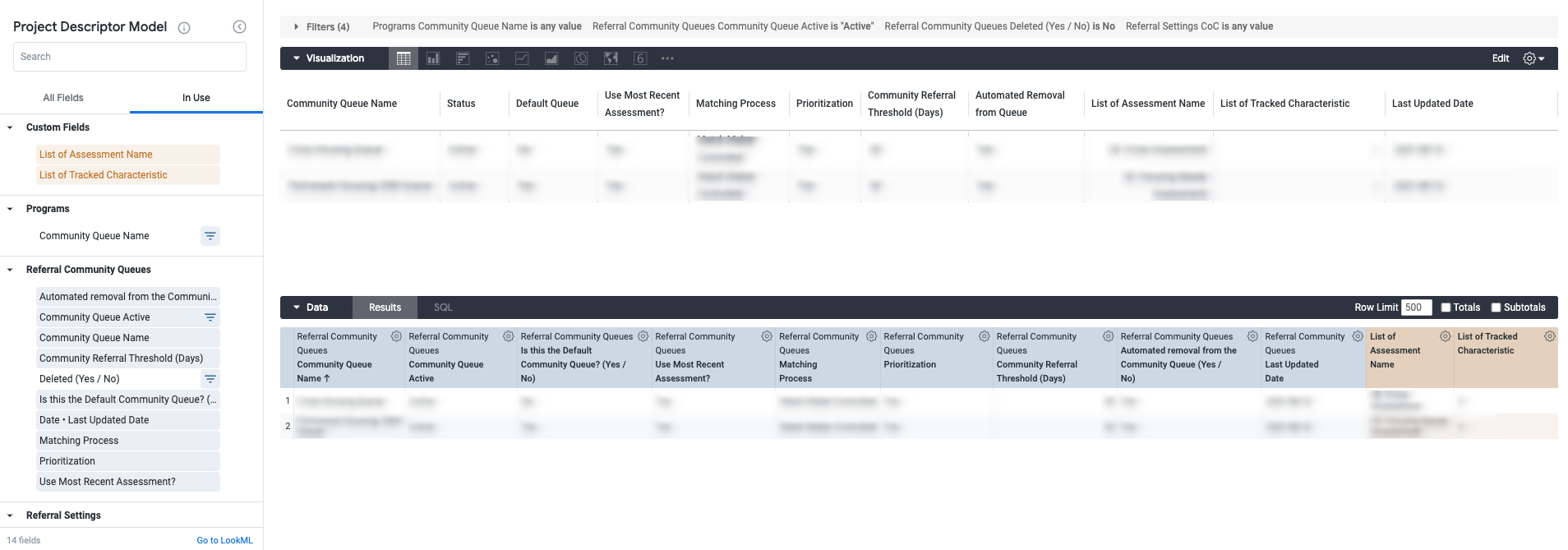
Community Queue Detail
This Look contains a table with Community Queue details including Community Queue Name, Community Queue Status, Default Community Queue, Most Recent Assessment, Matching Process, Prioritization, Community Referral Threshold (days), Automated Removal from Community Queue, Last Updated Date, and a list of assessments and tracked characteristics.
- Dimensions
-
- Community Queue Name
- Community Queue Active
- Is this the Default Community Queue? (Yes/No)
- Use Most Recent Assessment?
- Matching Process
- Prioritization
- Community Referral Threshold (Days)
- Automated Removal from Community Queue (Yes/No)
- Last Updated Date
- Custom Fields
-
- List of Assessment Name
- List of Tracked Characteristic
- “Explore from Here”
- There are no drill downs available for this Look.
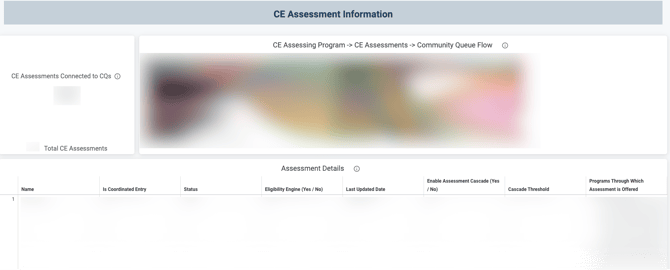
CE Assessment Information
The CE Assessment Information section includes the CE Assessments Connected to CQs, CE Assessing Program -> CE Assessments, -> Community Queue Flow, and Assessment Details tiles.
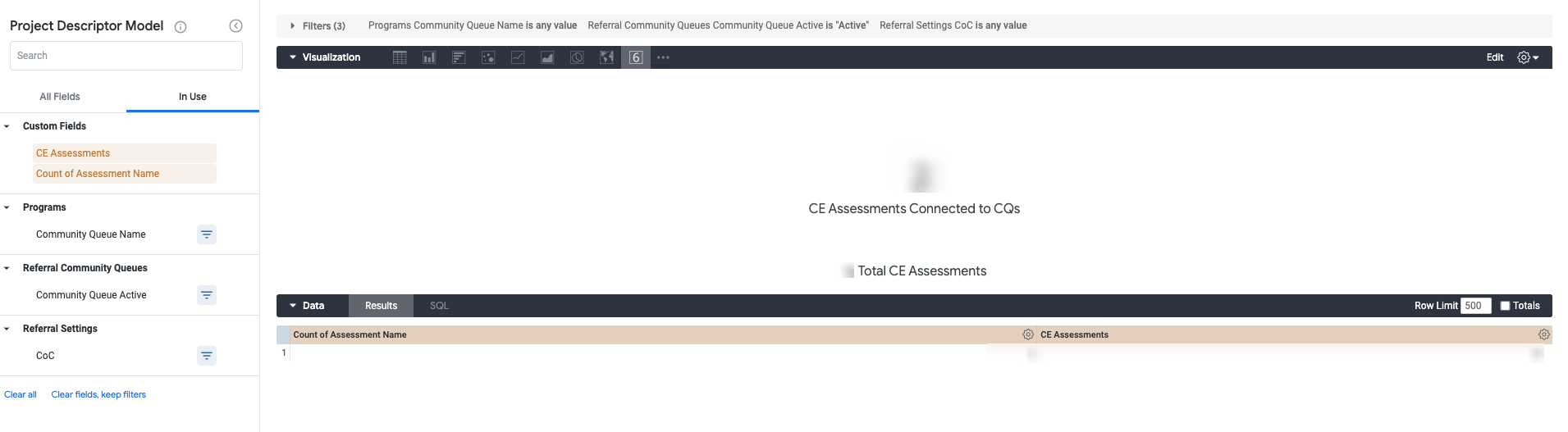
CE Assessments Connected to CQs
This Look contains a single value visualization with a count of CE assessments connected to Community Queues as well as a comparison below with a count of all CE assessments.
- Custom Fields
-
- Count of CE Assessments
- Count of Assessment Name
- “Explore from Here”
- Select the value in the CE Assessments column for a drill down containing Assessment ID, Assessment Name and Type.
 CE Assessing Program -> CE Assessments -> Community Queue Flow
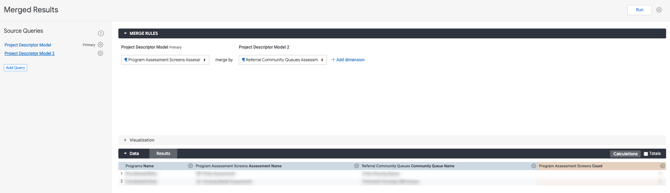
This Looks is a merged query with a Sankey visualization depicting the flow from assessing program to assessment to community queue. Queries are merged by the assessment name dimension.
|
Look |
Dimensions |
Measures |
|
Primary Look |
Assessment Name - Program Assessment Screens Program Name |
Count - Program Assessment Screens |
|
Secondary Look |
Assessment Name - Referral Community Queues Community Queue Name - Referral Community Queues |
None |
- “Explore from Here”
-
- When “Explore from Here” is selected, the merged results will appear. The drill down available in the count column displays Assessment ID, Assessment Name and Type.
Example Merged Results Look:
Example Primary Look:
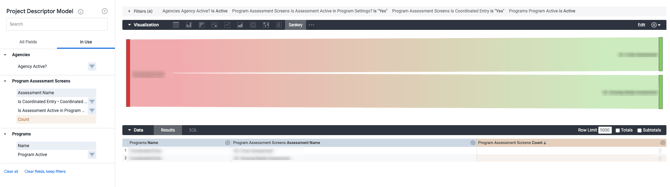
Example Secondary Look:

Assessment Details
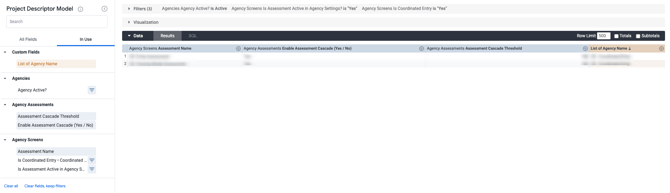
This Looks is a merged query with a table visualization with coordinated entry assessment details. There are 3 queries that are merged by Screens Assessment Name and Agency Screens Assessment Name, and Screens Assessment Name and Program Assessment Screens Assessment Name. This table contains Assessment Name, Is Coordinated entry (Yes/No), Status, Eligibility Engine (yes/No), Last Updated Date, Enable Assessment Cascade (Yes/No), Assessment Cascade Threshold (days), and List of Program Names.
|
Look |
Dimensions |
Measures |
Custom Fields |
|
Primary Look |
Assessment Name Is Coordinated Entry Eligibility Engine Last Updated Date Status |
None |
None |
|
Secondary Look |
Assessment Name - Program Assessment Screens |
List of Program Names |
None |
|
Tertiary Look |
Assessment Name - Agency Screens Assessment Cascade Threshold Enable Assessment Cascade |
None |
List of Agency Names |
- "Explore from Here"
-
- When “Explore from Here” is selected, the merged results will appear. There are no drill downs available but when selecting List of Agency Names or List of Program Name, the associated Look will load (List of Agency Names - Tertiary Look; List of Program Names - Secondary Look).
Example Merged Results:
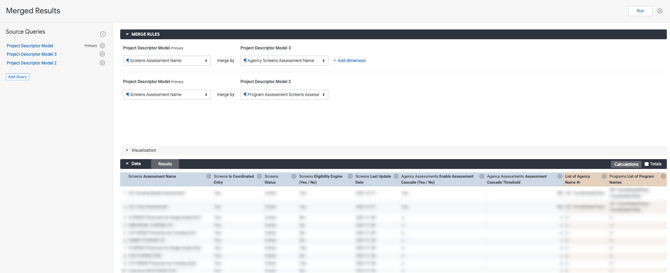
Example Primary Look:
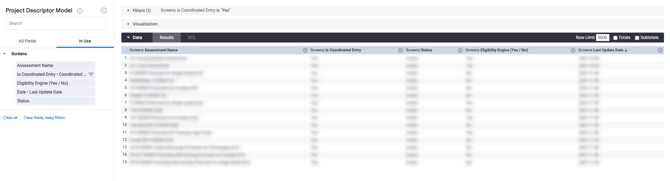
Example Secondary Look:
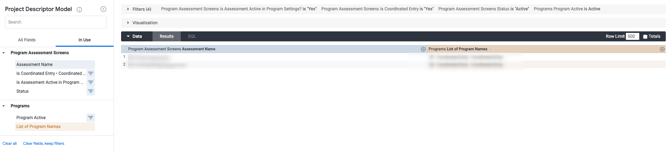
Example Tertiary Look:
Updated: 10/15/2026